Oregon’s Universal Health Plan: History, Development, and Employer Questions
By James Russell, Founder & Principal Consultant, PDX Benefits LLC
Research reviewed August 30, 2026. Editorial draft for approval; not published.
Oregon is developing a publicly funded universal health plan. The Universal Health Plan Governance Board is preparing recommendations for lawmakers, with legislative consideration described for 2027. The plan is still being developed; it is not coverage people can enroll in today. Official board overview
When I look at a proposal like this, I want to understand how it would work for the people depending on it. For employers, that means looking at more than cost alone. It also means asking how employees would get care, how their families would be covered, and what support they would need through a change. Understanding how Oregon reached this point gives us a better starting place for those questions.
What Oregon’s Universal Health Plan project is
The Universal Health Plan Governance Board, or UHPGB, was established through Senate Bill 1089 in 2023. Its assignment is to work out how a statewide health plan would be funded and run. Oregon law also directs the board to examine whether the institutions involved would be ready and what federal permissions would be needed. ORS Chapter 751
There is a lot to work through between describing a goal and making it work in someone’s daily life. I would look for answers about getting an appointment, continuing treatment, understanding coverage, and knowing where to turn for help. Those are useful ways to evaluate the details as they develop.
The history: financing studies before the current board
The current board’s work did not begin from scratch. Its historical account points back to House Bill 3260 in 2013, which called for studying different ways to finance health care, including a publicly funded single-payer system. That research helped lay the groundwork for the planning that followed. Board’s 2025 status report, background section
Looking back helps us understand what earlier researchers were trying to solve. It also gives us a reason to ask how their assumptions compare with the situation today. I would want to know when a cost estimate was developed, which version of the plan it describes, and whether it has been updated before using it to help a business plan ahead.
2019–2022: the task force develops a framework
Senate Bill 770 in 2019 established the Joint Task Force on Universal Health Care to recommend a publicly funded system for Oregon residents. Its role was to develop a design for lawmakers to consider. This was an important step between studying financing options and putting together a more complete proposal. SB 770 legislative record
The task force’s 2022 recommendations addressed who would qualify, what would be covered, how the plan would be paid for, and who would oversee it. Its proposed approach included replacing patient copayments and deductibles with financing based on ability to pay. The report also recognized that more work was needed and recommended creating a governance board to carry it forward. 2022 task force executive summary
2022: voters approve a health-care-rights amendment
Oregon voters approved Measure 111, also called the HOPE Amendment, in 2022. It added a constitutional obligation concerning access to affordable, clinically appropriate, cost-effective health care. The board identifies this amendment as part of the foundation for its work. Historical account in the board’s status report
It helps to separate the commitment from the steps needed to carry it out. The amendment addresses access to care as a right. Developing a funding approach and working out how people would receive that care are further tasks. For a family or employer following the discussion, both the goal and the practical details deserve attention.
2023–2026: from governance to detailed plan development
After the 2023 legislation, board members were confirmed in February 2024, and the board first met in April 2024. Its early work included procedures, a work plan, principles, and review of the task force recommendations. During 2025, it developed preliminary recommendations and pursued financial, actuarial, and legal analysis. 2025 development report
The board’s current overview describes 2026 as a period of community engagement, financial modeling, legal analysis, and plan development. It identifies September 2026 for delivery of draft plan models and the 2027 legislative session for lawmakers’ consideration. The statutory deadline for presenting a comprehensive implementation plan is September 15, 2026. Neither milestone should be described as a coverage start date. Board timeline · Statutory reporting deadline
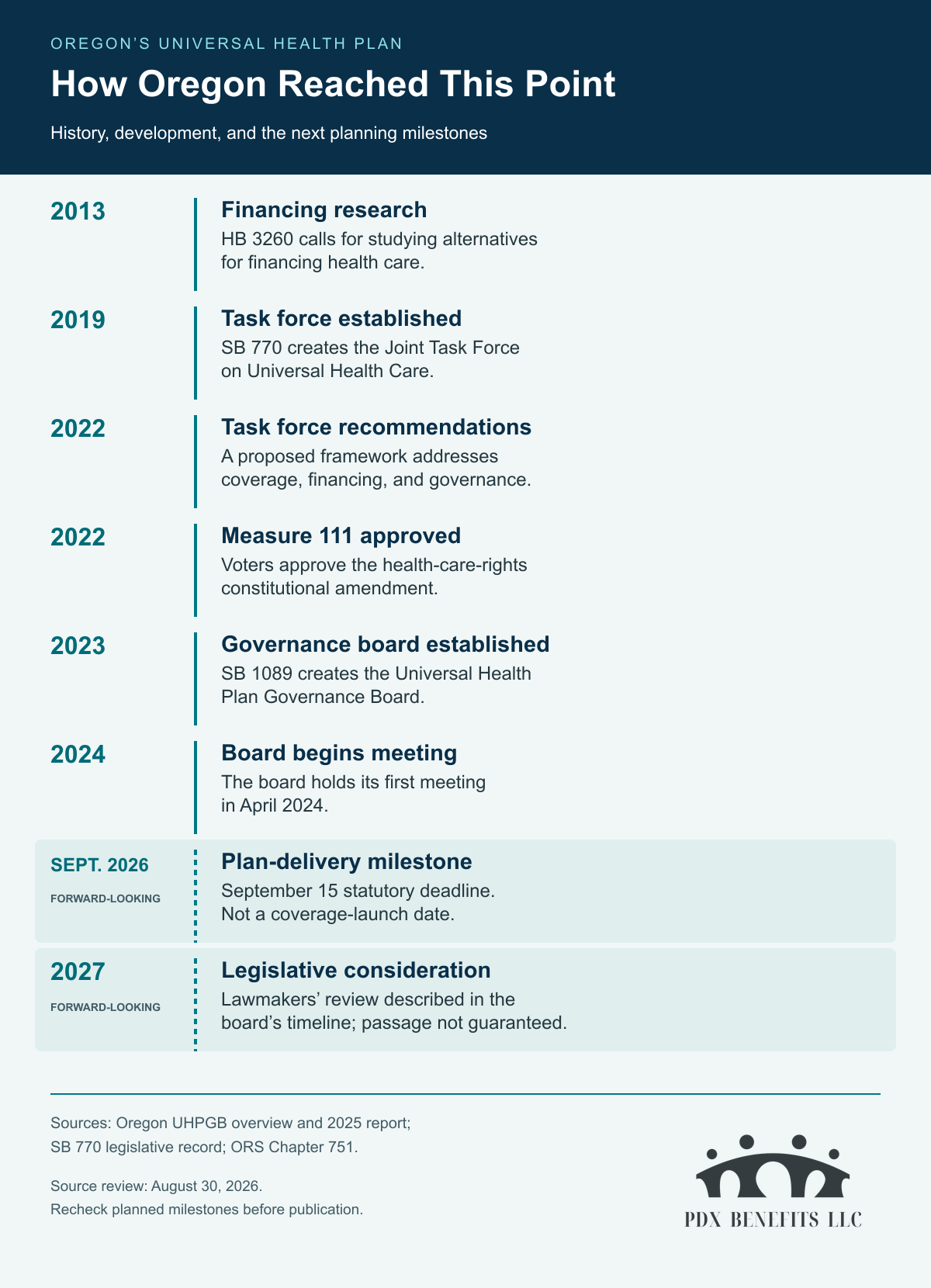
Historical and planned milestones from the board’s history report, SB 770, and current board timeline. Planned dates require a status check before publication.
Is universal health care on the November 2026 ballot?
The official materials reviewed for this article do not establish a November 2026 statewide vote on the board’s universal health plan. A board focus-group report describes potential legislative passage in 2027 or a legislative ballot referral in 2028 as the earliest possibilities in that planning sequence. That is not confirmation that a referral will occur. 2026 focus-group report, implementation steps
For now, the next step to follow is the board’s report and the response from lawmakers. If a ballot referral becomes part of that process, its specific language and election date will give us something concrete to review together.
Financing: compare total costs, not one headline
When comparing costs, I would start by putting the current arrangement and the proposed arrangement side by side. If a proposal would replace premiums with another form of payment, we need to understand both parts of that change. We also need to consider the cost of making the transition. Looking at a premium or a tax by itself would leave part of the picture out.
The questions I would bring to that conversation are straightforward: What would the business pay? What would employees and their families pay? Which current expenses would be replaced, and which would remain? A statewide estimate can help explain a proposal, but we still need to understand how its assumptions fit the people and business we are working with.
Oregon and Washington employers: questions worth preparing
For a team that lives or works across the Oregon–Washington border, I would pay particular attention to how the proposal addresses those different situations. Where employees live, where they work, and where their families receive care are all questions to bring into the review. We would need specific answers about cross-border coverage before explaining what a change would mean for that team.
You can start with information already useful for benefits planning: your renewal date, contribution approach, and the states where employees live and work. Invite general questions about access and communication without asking employees to share private medical details. Working through those questions with your benefits advisor gives everyone a clearer starting point. The PDX Benefits employer benefits strategy resources can help you organize that conversation.
Frequently asked questions
Did Measure 111 create the current governance board?
No. Measure 111 was the 2022 constitutional amendment. Senate Bill 1089 established the governance board in 2023. The task force that preceded the board was established through 2019 legislation. These are related but separate milestones. Board overview
Does September 2026 mean coverage begins then?
No. September is a plan-delivery milestone in the official timeline, not an enrollment or coverage-launch date. A report to lawmakers should not be treated as an instruction to cancel or replace existing insurance. Statutory deadline
Can an employer calculate its final cost from these materials?
Not a final cost for its own business from the information presented here. That would require the applicable funding rules, effective dates, and a comparison with the company’s current arrangement. A benefits advisor, tax professional, and legal advisor can help evaluate those details when they are available.
What to watch next
Oregon’s Universal Health Plan has developed through years of research, recommendations, and more detailed planning. As the next recommendations become available, I would look at how the pieces work together: funding, eligibility, access to providers, and support through the transition. My goal is to help employers understand the information well enough to ask useful questions and consider what it means for their own teams. There is still more to learn, and that understanding should develop alongside the proposal.
This article is for general education, not a political endorsement or legal or tax advice. It does not change existing coverage. Check policy status and sources again before publication or a benefits decision.
About the Author
James Russell is the Founder & Principal Consultant of PDX Benefits LLC. He helps employers understand their benefits choices, prepare for renewal, and communicate with their teams. His approach centers on clear explanations, collaboration, and understanding the needs of the people a benefits decision will affect.