2027 Open Enrollment Communication Checklist for Oregon and Washington Employers
A strong 2027 open enrollment campaign should tell employees what is changing, what each option costs, where the plan works, what decisions they must make, and the exact deadline for acting. Oregon and Washington employers should build communications around their own plan-year calendar—not Marketplace dates—and repeat the key decision points through more than one channel.
By James Russell, Founder & Principal Consultant, PDX Benefits LLC
Open enrollment is not just a benefits announcement. It is a short decision window in which employees may need to compare payroll deductions, provider networks, prescription coverage, deductibles, out-of-pocket limits, and dependent needs. If the communication arrives as one long email or a stack of attachments, important details are easy to miss.
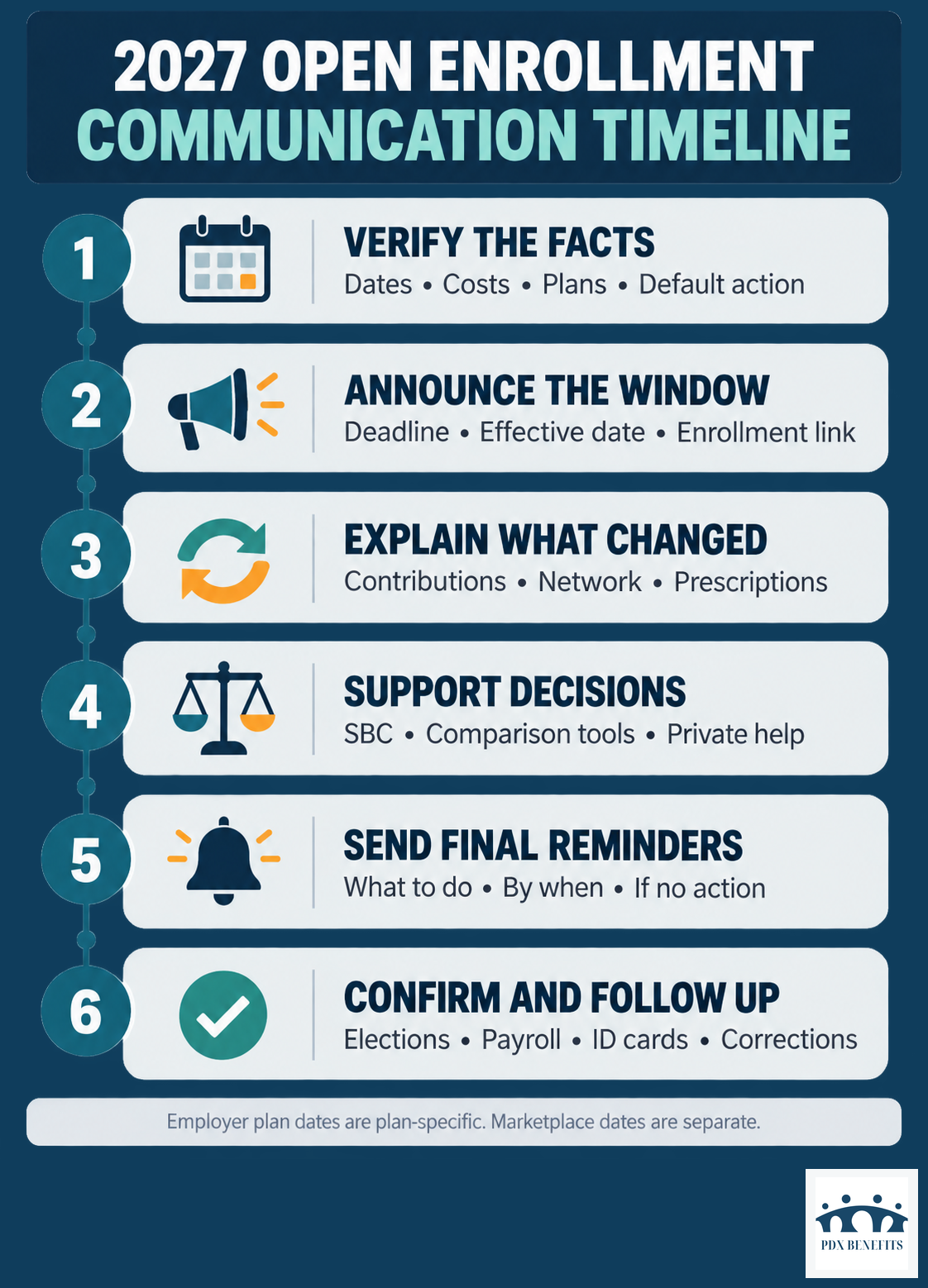
The better approach is a sequence. Confirm the facts first. Announce the timeline. Explain what changed. Give employees a practical comparison method. Send reminders. Then confirm elections and next steps after the window closes.
First, separate your employer deadline from Marketplace open enrollment
There is no universal Oregon or Washington open enrollment date for employer-sponsored health plans. Your election window and effective date depend on the employer, plan year, carrier, and administrator. Employees should follow the deadline stated in the employer's enrollment materials.
That is different from individual and family Marketplace coverage. Oregon's Explore Health and Washington Healthplanfinder list the 2027 individual-market open enrollment period as November 1, 2026 through January 15, 2027. Those dates do not automatically apply to an employer plan, Medicare, Oregon Health Plan, or Apple Health.
Oregon is also moving to its own full state-based Marketplace for plan year 2027. That change matters when an employee needs individual coverage, but it should not be presented as a change to the employer's group plan.
Eight weeks before enrollment: confirm the facts
Do not draft employee messages until the renewal information is settled enough to be accurate. Confirm the enrollment window, 2027 effective date, eligibility rules, waiting periods, employee and employer contributions, available plans, network names, prescription formularies, HSA or FSA options, and what happens if an employee takes no action.
Create one source-of-truth worksheet for HR, payroll, the broker, and the carrier or administrator. Label any item that is still pending. A clean internal worksheet prevents different employees from receiving different answers.
Item to verify | What employees need to know | Owner |
|---|---|---|
Enrollment timing | Opening date, closing date, time zone, and effective date | HR or administrator |
Plan changes | What is new, removed, or materially different | Broker and carrier |
Employee cost | Per-pay-period contribution for each tier and plan | Payroll and HR |
Provider access | Exact 2027 plan and network name | Carrier and broker |
Prescriptions | Formulary, pharmacy network, tiers, and utilization rules | Carrier or PBM |
Required action | Active election, passive renewal, or waiver steps | HR or administrator |
Help | Where plan, eligibility, and personal questions should go | HR, broker, carrier |
Employees should also be directed to verify their doctors, hospitals, behavioral-health providers, pharmacies, and prescriptions against the exact 2027 plan. The carrier name alone is not enough because one carrier can offer multiple networks and formularies.
Four to six weeks before: announce the timeline
The first employee message should be short. State when enrollment opens, when it closes, when coverage begins, whether action is required, and where the comparison materials will live. Put the deadline near the top and include the time zone if the enrollment system closes at a specific hour.
Use more than one channel: email, an employee portal, a meeting invitation, payroll notices, or printed materials for employees who do not regularly use email. Keep the core facts identical across channels. Provide an accessible way to request language or format assistance, and avoid asking employees to share medical details in a group meeting or ordinary email.
Two to three weeks before: explain what changed
Lead with the questions employees are already asking: What will come out of my paycheck? Did the deductible or out-of-pocket limit change? Are my doctors and prescriptions covered? Do I need to enroll again? Can I add or remove a dependent?
Pair the employee contribution sheet with the Summary of Benefits and Coverage, or SBC. Federal rules generally require the SBC with open-season materials when employees have an active election or plan-change opportunity. Automatic-renewal situations have different timing rules, so the carrier, administrator, or benefits counsel should confirm the final disclosure calendar rather than relying on a blanket “30 days before enrollment” rule.
Required notices and employee education are related, but they are not the same thing. A compliant notice package may still be hard to understand. A plain-language comparison may still be incomplete if required documents are missing. Review both tracks before distribution.
During enrollment: make the decision easier
Give employees a repeatable comparison method. For each option, compare the per-pay-period contribution, deductible, out-of-pocket maximum, copays or coinsurance, provider network, prescription coverage, and employer funding such as an HSA contribution. Then ask employees to consider expected care, dependents, medications, preferred providers, and tolerance for higher payroll costs versus higher point-of-care costs.
For definitions and plan-design context, employees can review the PDX Benefits guide to health benefits. For plan-specific decisions, the actual 2027 plan documents and carrier tools control.
Managers should not recommend a plan for an employee or collect personal health information. Give them an escalation path: administrative questions to HR, plan and network questions to the carrier or broker, and private personal situations through the appropriate secure channel.
Final week: prevent missed deadlines
Send at least one clear reminder that repeats the deadline, required action, and enrollment link. A useful final reminder answers three questions in the first few lines: What do I need to do? By when? What happens if I do nothing?
Do not assume passive renewal means nothing changes. Contributions, cost sharing, network participation, drug coverage, and HSA or FSA elections can change even when the employee stays with the same carrier. State the actual default outcome only after it has been verified with the plan administrator.
After enrollment: confirm elections and next steps
Provide a confirmation path so employees can verify their elected plan, coverage tier, dependents, payroll deduction, and effective date. Tell them how quickly to report an apparent error. Coordinate payroll files, carrier eligibility, ID-card expectations, and HSA or FSA setup before the new plan year begins.
Open enrollment also should not be described as the only time coverage can change. Federal special-enrollment rights may apply after events such as loss of other coverage, marriage, birth, adoption, or certain Medicaid and CHIP changes. The deadlines differ by event, so employees should contact HR promptly rather than assuming they can wait.
Oregon and Washington considerations for 2027
For Oregon residents who need individual coverage, Explore Health replaces the federal Marketplace pathway for plan year 2027. Oregon's current enrollment page lists November 1, 2026 through January 15, 2027, with December 31 as the deadline for January 1 coverage. Keep that guidance separate from the employer plan's election window.
Washington Healthplanfinder also lists November 1, 2026 through January 15, 2027 for 2027 individual Marketplace coverage. Its current guidance says selections made by December 31 can begin January 1, while January 1–15 selections begin February 1. Apple Health enrollment remains available year-round for eligible residents.
Employers with Medicare-eligible employees or dependents should also confirm delivery of the annual Medicare Part D creditable-coverage notice before October 15. That notice has its own audience and deadline; it is not a substitute for the open enrollment campaign.
A concise message framework
Every employee message should answer six things:
Cost: What will the employee pay per pay period?
Coverage: Which plans, networks, and formularies apply for 2027?
Changes: What is different from the current year?
Action: Must the employee enroll, waive, or confirm dependents?
Deadline: What is the exact date and time?
Help: Who handles administrative, plan, and personal questions?
That framework is intentionally simple. It helps prevent a comprehensive benefits packet from becoming an unreadable wall of information.
Frequently asked questions
Is my employer's deadline the same as Oregon Explore Health or Washington Healthplanfinder?
Usually not. The employer sets its own group-plan election window with the carrier or administrator. The November 1–January 15 dates are for the individual Marketplace in each state.
What should an open enrollment email include?
Include the opening and closing dates, effective date, whether action is required, a concise summary of changes, employee contribution information, links to plan documents, the enrollment method, and help contacts.
What happens if an employee does nothing?
It depends on the employer and plan. Coverage may renew, change, or end; dependent and account elections may also require separate action. State the default only after verifying it.
Which document should employees compare first?
Start with the employee contribution sheet and SBC, then review the exact plan's provider network, formulary, and fuller plan documents for details that affect the household.
Can an employee enroll after the deadline?
Possibly, if a qualifying special-enrollment event applies. The event, timing, documentation, and plan rules matter, so the employee should contact HR promptly.
Does choosing a high-deductible health plan automatically make someone HSA-eligible?
No. HSA eligibility also depends on other coverage, Medicare enrollment, tax-dependent status, and monthly eligibility rules. Employees should review their situation before contributing.
Build the campaign before the questions start
The strongest enrollment communications do not try to answer everything in one email. They give employees the right information in the right order, create a private path for individual questions, and leave enough time to compare the actual 2027 options.
PDX Benefits helps employers review renewal choices, organize the employee decision experience, and coordinate the communication calendar. If you want a second set of eyes on your 2027 process, review your enrollment plan with PDX Benefits.
Primary sources
Oregon Division of Financial Regulation health coverage guidance
Washington Healthplanfinder federal changes and 2027 enrollment dates
Washington Office of the Insurance Commissioner: how health insurance works
U.S. Department of Labor health plan information and disclosures
About the Author
James Russell is the Founder and Principal Consultant of PDX Benefits LLC. He helps employers and individuals evaluate health-plan options, understand tradeoffs, and make benefits decisions with clearer information.
Educational disclaimer: This article provides general educational information, not legal, tax, medical, or plan-specific advice. Requirements can vary by employer size, plan type, funding arrangement, eligibility, and jurisdiction. Confirm final notices, deadlines, and plan terms with the carrier, administrator, broker, and qualified counsel.