2027 HSA and FSA Limits: An Employer’s Section 125 Planning Checklist
Employers preparing for 2027 open enrollment should coordinate their Section 125 plan document, medical-plan eligibility, HSA and FSA election materials, payroll deductions, employer contributions, and administrator setup before communicating benefits to employees. The IRS has set the 2027 HSA limits at $4,500 for self-only coverage and $9,000 for family coverage, along with new HDHP thresholds. As of October 4, 2026, however, the IRS had not yet issued the 2027 health-FSA salary-reduction or carryover limits, so employers should not reuse the 2026 figures as if they were final.
By James Russell, Founder & Principal Consultant, PDX Benefits LLC
Last reviewed: October 4, 2026
The practical challenge is not memorizing three acronyms. It is making sure the medical plan, account eligibility, written elections, payroll system, employee communications, and administrator records all describe the same arrangement. Section 125, an HSA, and a health FSA can interact, but they are not interchangeable.
What are the confirmed 2027 HSA and HDHP limits?
The IRS published the 2027 HSA and high-deductible health plan figures in Revenue Procedure 2026-24. These are federal amounts that apply in Oregon and Washington; they are not separate state limits.
2027 item | Self-only | Family |
|---|---|---|
HSA contribution limit | $4,500 | $9,000 |
Minimum HDHP deductible | $1,750 | $3,500 |
Maximum HDHP out-of-pocket expense | $8,700 | $17,400 |
The HSA contribution limit is an aggregate annual limit. Employee salary reductions, employer contributions, and other contributions all count toward the same limit. The HDHP out-of-pocket ceiling excludes premiums, and it is a statutory maximum—not a prediction of what every plan will charge.
HSA eligibility is also more than a plan label. An employee generally must have qualifying HDHP coverage, lack disqualifying other coverage, not be enrolled in Medicare for the applicable month, and not be another taxpayer’s dependent. The IRS Form 8889 instructions explain the monthly eligibility framework. Employers should avoid promising that every employee enrolled in a plan called “HDHP” can contribute.
Has the IRS announced the 2027 health-FSA limit?
Not yet. As of October 4, 2026, the IRS had not issued an official 2027 health-FSA salary-reduction limit or maximum carryover amount in the primary guidance reviewed for this article.
The latest official figures are for plan years beginning in 2026: a $3,400 health-FSA salary-reduction limit and, if the written plan permits carryover, a maximum optional carryover of $680. Those figures appear in the IRS 2026 inflation-adjustment release. They should not be labeled as 2027 limits.
Employers can prepare systems and communications now, but the FSA dollar fields should remain marked “to be confirmed” until the IRS publishes final 2027 guidance. This is especially important for vendors that copy a prior-year enrollment file forward automatically.
How do carryover, grace periods, and run-out periods differ?
A health FSA does not automatically include a carryover or grace period. The employer’s written plan controls which feature is available.
Carryover: The plan may allow up to the federal maximum, a smaller amount, or none. A permitted carryover is separate from the employee’s new plan-year salary-reduction election.
Grace period: A plan may allow additional time—up to two months and 15 days after the plan year ends—to incur eligible expenses.
Run-out period: This is a claims-submission window. It does not create new eligible expenses after the permitted coverage period.
For a health FSA, the plan generally cannot use both a carryover and a grace period for the same relevant year. IRS Notice 2020-33 describes the carryover framework. Employers should confirm the actual plan terms and employee submission deadline with the FSA administrator before drafting reminders.
Why review the Section 125 plan before changing payroll?
A cafeteria plan under Internal Revenue Code Section 125 must be a written employer plan that states the available benefits, eligibility rules, and election procedures. The IRS cafeteria-plan FAQ provides a useful federal overview.
The operational order matters. First confirm the written plan and amendments. Then configure elections and payroll. Finally, communicate the arrangement employees can actually elect. Announcing a carryover, midyear-election right, or pretax deduction before confirming that the written plan supports it can create an avoidable mismatch.
Federal Section 125 and HSA rules apply in both Oregon and Washington, but state tax effects can differ. Washington does not impose a general individual income tax, so employers should not promise identical state-income-tax results across the two states. This article addresses federal coordination and does not calculate an employer’s or employee’s tax savings.
For broader plan-design context, review how to coordinate the medical plan with account-based benefits. The underlying coverage must be evaluated separately from the payroll and account mechanics.
Can an employer offer an HSA and a health FSA together?
Possibly, but the FSA design matters. A general-purpose health FSA that can reimburse medical expenses before the HDHP deductible is met can make an employee ineligible to contribute to an HSA. A properly designed limited-purpose FSA, often restricted to dental and vision expenses, or a post-deductible arrangement may be compatible.
Do not assume compatibility from the product names alone. Confirm the medical plan, FSA plan document, employee’s other coverage, spouse’s coverage, and administrator setup. Employees also need a clear explanation of which account pays which expenses.
Employers should separately decide how employer HSA contributions will be funded and timed. Because employer and employee contributions share the annual limit, payroll and the HSA administrator need a common year-to-date record. Employees approaching age 55 may have an additional federal HSA catch-up opportunity, but eligibility is individual and each eligible spouse needs their own HSA for a catch-up contribution.
Can employees change HSA or FSA elections during the year?
The rules are different.
Section 125 medical-plan and health-FSA elections are generally made before the coverage period and are generally irrevocable for the plan year. A written plan may allow specific midyear changes permitted under federal rules, and the requested change must satisfy the applicable consistency requirements. A marriage, birth, employment change, residence change, or other event does not automatically allow every possible election change. IRS Notice 2022-41 illustrates how specific permitted changes depend on the applicable rule and plan terms.
HSA salary-reduction contributions through a cafeteria plan are different. Employees generally may prospectively start, stop, or change those HSA salary reductions during the year for compensation not yet available. That flexibility should not be copied into health-FSA or medical-premium election language.
What should employers coordinate before enrollment opens?
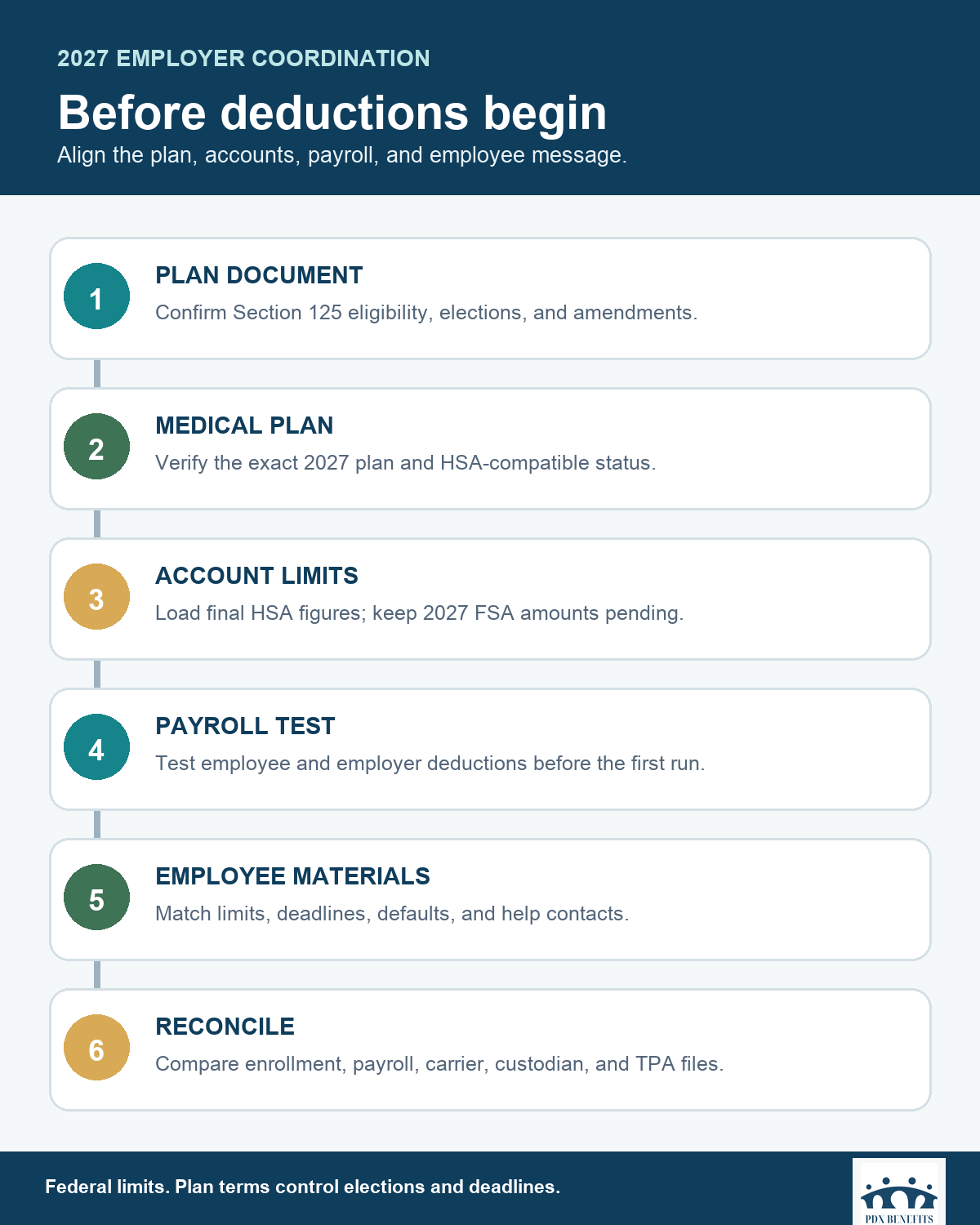
Use one implementation worksheet shared by HR, payroll, the broker, and the third-party administrator. Each line should have an owner and a verified source.
Medical plan: Confirm the exact 2027 plan, effective date, network, funding arrangement, and whether the plan is HSA-compatible.
Section 125 document: Confirm eligibility, election timing, permitted midyear changes, premium-conversion terms, and any required amendments.
HSA setup: Enter the 2027 limits, employer contribution, payroll frequency, catch-up handling, and year-to-date controls.
FSA setup: Keep the 2027 limit pending until official IRS guidance is released; verify carryover or grace-period terms and the run-out deadline.
Account compatibility: Identify whether a health FSA is general-purpose, limited-purpose, or post-deductible and explain the effect on HSA eligibility.
Payroll testing: Test employee and employer deductions before the first live payroll. Confirm rounding, effective dates, and file transfers.
Employee materials: Make the plan year, tax year, limits, deadlines, default elections, and help contacts consistent across every document.
Post-enrollment audit: Reconcile elections among the enrollment platform, payroll, carrier, HSA custodian, and FSA administrator.
The biggest timing distinction is easy to miss: HSA limits apply by calendar year and monthly eligibility, while the health-FSA salary-reduction limit applies by cafeteria-plan year. A non-calendar-year plan therefore needs especially careful communication.
Frequently asked questions
What are the HSA contribution limits for 2027?
The 2027 federal limit is $4,500 for self-only coverage and $9,000 for family coverage. Employee, employer, and other contributions count together toward the applicable limit.
What are the 2027 HDHP thresholds?
For the general federal HDHP definition, the minimum annual deductible is $1,750 for self-only coverage and $3,500 for family coverage. The maximum out-of-pocket expense is $8,700 and $17,400, respectively, excluding premiums.
What is the 2027 health-FSA limit?
As of October 4, 2026, the IRS had not issued the official 2027 health-FSA salary-reduction limit or maximum carryover amount. Employers should wait for the final release before publishing a 2027 amount.
Does a Section 125 plan have to be in writing?
Yes. A cafeteria plan must be a written employer plan that describes benefits, participation, and election rules. Employers should have counsel or the plan administrator confirm amendments and effective dates.
Can employees change FSA elections after open enrollment?
Generally, health-FSA elections are prospective and irrevocable for the plan year unless the written plan allows a specific permitted change and the requested change satisfies the applicable rules.
Can employees change HSA payroll contributions during the year?
Generally, yes. HSA salary-reduction contributions through a cafeteria plan may be changed prospectively during the year for compensation not yet available, subject to payroll procedures and the annual contribution limit.
Build the system before you announce the benefit
The best 2027 enrollment materials will not fix a plan document, payroll file, or eligibility rule that was never aligned. Confirm the legal and administrative structure first, test it second, and communicate it third.
PDX Benefits helps Oregon and Washington employers coordinate plan decisions with enrollment, payroll, and employee communications. If you want a second review before deductions begin, review your 2027 benefits implementation plan.
About the Author
James Russell is the Founder and Principal Consultant of PDX Benefits LLC. He helps employers and individuals evaluate health-plan options, understand tradeoffs, and coordinate benefits decisions with clearer information.
Educational disclaimer: This article provides general educational information, not legal, tax, accounting, medical, or plan-specific advice. Requirements and tax effects can vary by plan document, employer, employee, funding arrangement, eligibility, and jurisdiction. Confirm final elections, amendments, payroll treatment, and account compatibility with qualified counsel, tax advisers, payroll providers, administrators, carriers, and custodians.