Oregon ACA Small-Group Health Insurance: What the 2027 Rate Requests Mean
Oregon ACA Small-Group Health Insurance: What the 2027 Rate Requests Mean
By James Russell, Founder & Principal Consultant, PDX Benefits LLC
Updated August 17, 2026
Oregon has finalized rates for 2027 Affordable Care Act-compliant small-group health plans. The Oregon Division of Financial Regulation reduced insurers’ proposed market-wide average increase from 17% to an approved 15.5%. That is now a final regulatory decision, but it still is not a prediction that every Oregon small employer will receive a 15.5% renewal increase.
For employers, the practical message is straightforward: replace the preliminary 17% budgeting assumption with the approved market average, then evaluate the actual carrier renewal when it arrives. A business’s final premium change can differ because of its carrier, product, plan, network, service area, employee ages, dependent enrollment, contribution strategy, and benefit changes.
Key takeaways for Oregon employers
- Final market average: Oregon’s approved 2027 average increase for the ACA-compliant small-group market is 15.5%.
- Lower than requested: Insurers initially requested a weighted average increase of 17%, and DFR reduced that market-wide figure by 1.5 percentage points.
- Not every renewal: The approved average combines multiple insurers and plans. It does not describe every carrier, product, or employer.
- Market scope: This article addresses Oregon ACA-compliant small-group coverage for employers with one to 50 employees.
- Best next step: Review the employer’s actual renewal and compare alternatives using the same census, effective date, contribution assumptions, and benefit priorities.
What did Oregon insurers request for 2027?
On August 18, 2026, DFR announced final 2027 rate orders for Oregon’s individual and small-group health insurance markets. In the small-group market, the final orders reduced insurers’ proposed weighted average increase from 17% to 15.5%.
The final order replaces the preliminary status described in the original version of this article. Employers no longer need to wait for a statewide regulatory decision. They should now focus on how the approved carrier and plan rates appear in their own renewal.
Review DFR's official announcement of the final 2027 health insurance rates and its central Oregon health-rates page, which provides access to the 2027 small-group final orders.
Why the 15.5% average may not match your renewal
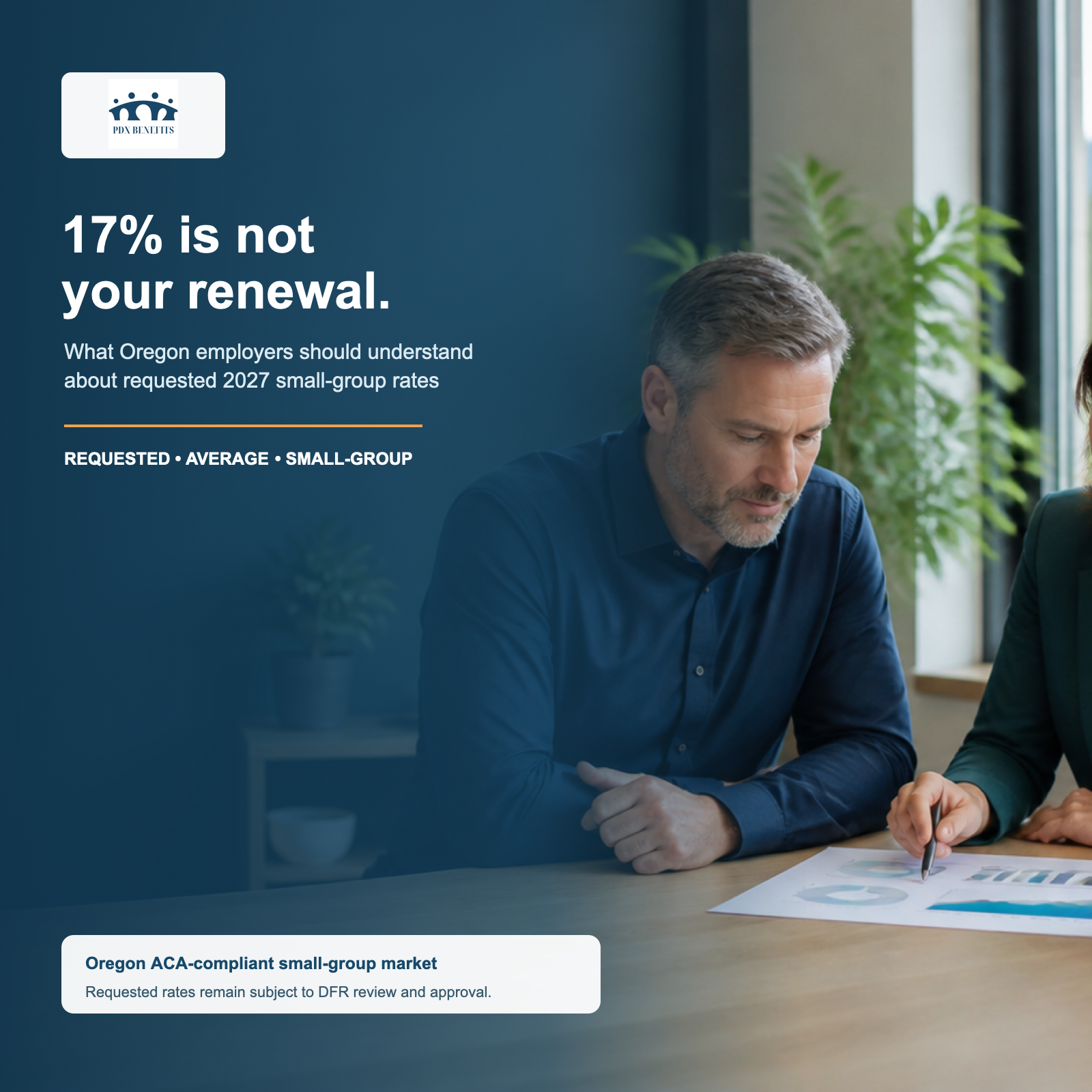
A market average is useful for understanding overall direction. It cannot replace an employer-specific renewal analysis. The 15.5% figure reflects the average across Oregon’s ACA-compliant small-group market, while a particular employer’s renewal applies the relevant carrier’s approved rates to that employer’s coverage and enrolled population.
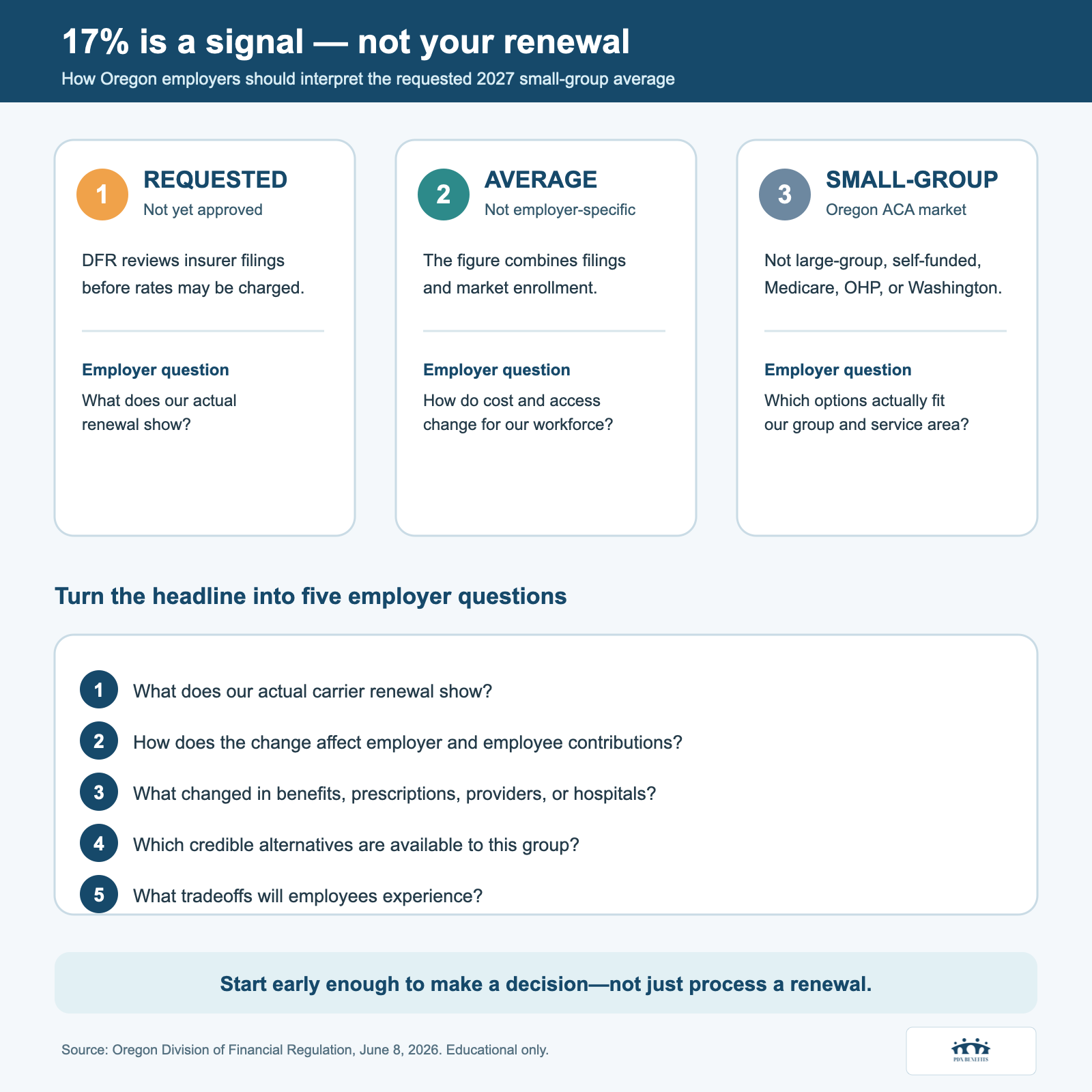
When reviewing a renewal, separate four questions:
1. What did DFR approve for the applicable carrier and product? This establishes the regulated rate framework.
2. What changed for this employer? Employee ages, enrollment, dependent participation, service area, and plan selections can affect premium.
3. What changed in the coverage? Provider networks, prescription formularies, cost sharing, and plan availability may matter as much as the percentage change.
4. What does the employer want to protect? Employer-cost stability, employee deductions, provider access, benefit richness, and administrative simplicity can lead to different decisions.
## Requested rates, approved rates, and employer renewals
These three numbers should not be used interchangeably.
- A requested rate is the change an insurer submits to the regulator for review.
- An approved rate is the change allowed under the regulator’s final order.
- An employer renewal is the carrier’s application of the approved rating structure to a specific group and its selected coverage.
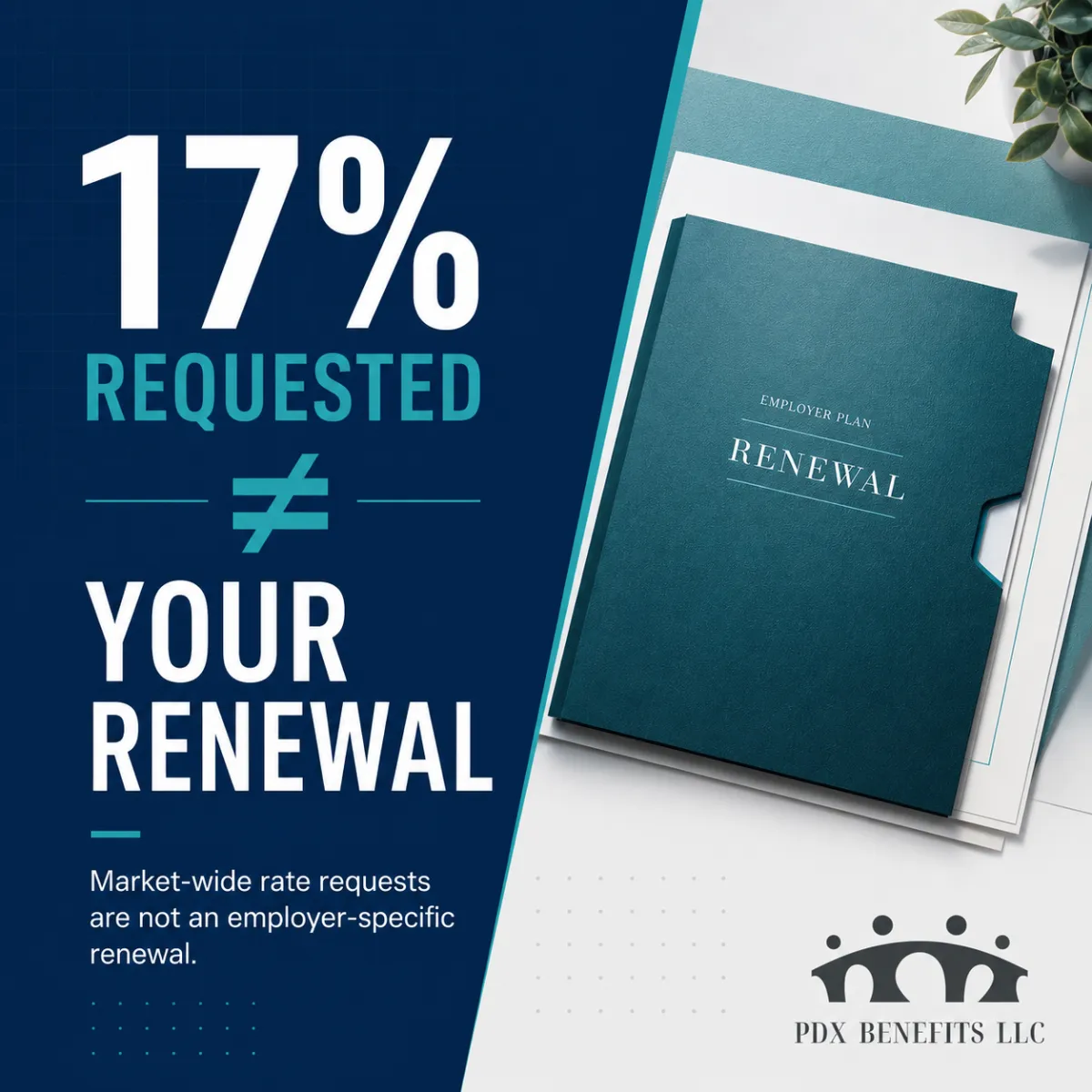
Oregon insurers originally requested a weighted average small-group increase of 17%. DFR’s final orders brought the approved market-wide average to 15.5%. That regulatory reduction is meaningful, but the employer’s renewal remains the number that should drive its budget and plan decision.
How Oregon reviews small-group health insurance rates
DFR reviews rates for health plans sold to individuals and small employers. The process examines whether proposed premiums are actuarially supported and neither excessive nor inadequate. Regulators review insurer assumptions, projected health care costs, administrative expenses, benefits, enrollment, and other filing information before issuing final orders.
The 2027 process moved through distinct stages. Insurers submitted requested rates, DFR conducted its review and received public input, the division issued proposed decisions, and final orders followed on August 18. Employers reading older articles or filing summaries should check the publication date and confirm whether a number was requested, proposed, or final.
DFR explains the process in its official guide to understanding health insurance rate review. The division also maintains a central Oregon health-rates page for pending and approved filings.
What employers should do when the renewal arrives
The final rate orders provide a better planning benchmark, but the renewal remains the decision document. Employers should review it in a consistent sequence.
Confirm the scope of the quote
Identify the carrier, legal product, provider network, plan design, service area, effective date, and eligible population. A comparison using different assumptions can make one option look better without showing a true like-for-like difference.
Reconcile the census
Confirm that employees, dependents, ages, coverage tiers, waivers, and work locations are accurate. Census changes can affect premium even when the employer keeps the same plan.
Compare benefits and access
Review deductibles, copays, coinsurance, prescription coverage, out-of-pocket limits, and provider networks. Carrier names alone do not establish access. Important doctors, facilities, pharmacies, and prescriptions should be checked against the exact 2027 plan and network.
Model employer and employee costs separately
An employer can retain a plan and change its contribution strategy, or change plans while pursuing a similar employer budget. Separating the plan decision from the contribution decision makes the tradeoffs easier to understand.
Allow time for communication
Build a calendar that includes leadership review, employee education, enrollment, payroll updates, and carrier submission deadlines. A rushed decision makes it harder to verify networks and prescriptions or explain why coverage is changing.
Questions to bring to a renewal meeting
Is the quoted change based on a requested rate, an approved rate, or the employer's final renewal?
Which carrier, product, network, service area, and effective date does the comparison use?
What changed because of rates, and what changed because of enrollment or plan design?
Have priority providers and prescriptions been checked against each exact option?
How would each option affect employer contributions and employee payroll deductions?
What employee communication and decision deadlines follow from the recommended approach?
Frequently asked questions
Are Oregon’s 2027 small-group rates final?
Yes. DFR issued final 2027 rate orders on August 18, 2026. The approved market-wide average increase for Oregon’s ACA-compliant small-group market is 15.5%.
What happened to the previously reported 17% increase?
The 17% figure was the weighted average requested by insurers. After review, DFR reduced the approved small-group market average to 15.5%. Content that still calls 17% the expected or pending statewide result is outdated.
Will every Oregon small employer receive a 15.5% increase?
No. The 15.5% figure is a market-wide approved average across insurers. A specific renewal depends on the applicable carrier, product, plan, service area, enrolled population, and other permitted rating factors.
Does this apply to large-group or self-funded plans?
No. This article addresses Oregon ACA-compliant small-group coverage. Large-group and self-funded arrangements use different pricing and regulatory frameworks.
Should an employer change carriers because of the approved average?
Not based on the average alone. Review the actual renewal, compare scoped alternatives properly, verify provider and prescription access, and evaluate how each option supports the employer’s cost and workforce priorities.
Plan with the employer’s actual renewal
The final 15.5% approved average confirms substantial cost pressure in Oregon’s 2027 small-group market, but it does not determine every employer’s outcome. The right response is neither to ignore the statewide result nor apply it mechanically to every group.
Good renewal planning uses the approved rates as context and the employer’s actual renewal as the starting point. From there, leadership can compare plan design, networks, prescriptions, employer contributions, employee deductions, and administrative impact using consistent assumptions.
About the Author
James Russell is the Founder and Principal Consultant of PDX Benefits LLC. He helps Oregon and Washington employers evaluate employee-benefit options, understand plan and network tradeoffs, and communicate benefit decisions to their teams. His work focuses on practical, supportable guidance rather than one-size-fits-all recommendations.
This article is for general educational purposes and is not legal, tax, or accounting advice. Rates, plan availability, provider networks, and coverage terms can change. Verify current information using official carrier documents and Oregon DFR materials.